Rising AI infrastructure investment is increasing demand for supporting components
AI is not only expanding the market for compute chips and cloud hardware. It is also strengthening demand for critical supporting components that enable reliable, high-density status indication across servers, data center equipment, industrial electronics, and I/O modules.
Market background
AI is driving a new expansion cycle in global data center and server infrastructure. Synergy Research Group reported that worldwide spending on data center hardware and software grew 34% year over year in 2024 to $282 billion, including a 48% increase in public cloud infrastructure spending. Dell'Oro Group reported that global data center capex increased 57% in 2025 and projected that it will exceed $1 trillion in 2026. IDC forecasts that AI infrastructure spending will reach $223 billion by 2028, with servers deployed in cloud environments accounting for 82% of the total. Together, these figures indicate that AI infrastructure investment is not a short-term spike, but an ongoing expansion cycle.
In this cycle, the spotlight often falls on GPUs, memory, liquid cooling, and high-speed interconnects, but demand for supporting components is also increasing. Light guides are one of those components. Their role is to transfer LED-based status signals from the PCB to visible front-panel, window, or enclosure positions. Bivar describes board-mount light pipes as solutions for bringing LED light to the user interface, which reinforces the fact that light guides are not merely simple plastic parts, but functional elements in the equipment status-visibility chain.
Why AI growth is increasing demand for light guides
More devices, more indication points
More servers, accelerator systems, power modules, switch boards, BMC boards, and I/O modules mean more operating, warning, and maintenance states must be shown clearly.
Higher density, tighter spacing
As channel density rises and panel space shrinks, the risk of optical crosstalk, color mixing, false reading, and maintenance confusion becomes more severe.
Reliability becomes critical
In AI servers and industrial electronics, stable optical output, dimensional consistency, and assembly compatibility matter directly to uptime and field service quality.
The first reason is the rising number of devices and status indication points. TrendForce reported that global AI server shipments grew 46% in 2024 and are expected to grow by nearly 28% in 2025. Its 2026 update further indicates that AI server shipments are expected to grow by more than 28% again in 2026. As the number of servers, accelerator systems, power modules, switch boards, BMC boards, and I/O modules continues to grow, more operating states, warning states, and maintenance states need to be displayed clearly.
The second reason is density. As AI infrastructure becomes more compact and more densely integrated, the spacing between adjacent LEDs becomes smaller and the number of channels per panel increases. That raises the risk of optical crosstalk, color mixing, false reading, and maintenance confusion. Based on this trend, it is reasonable to infer that high-density, multi-channel, anti-crosstalk light guide solutions will benefit more strongly than conventional general-purpose parts. This is an industry inference based on infrastructure scaling and density trends rather than a direct standalone market forecast for light guides.
The third reason is reliability. AI servers, industrial electronics, and data center systems are expected to operate continuously and reliably. In these environments, an incorrect status indication is not just a cosmetic issue; it affects maintenance efficiency and on-site judgment. That means light guides must provide stable optical output, dimensional consistency, and assembly compatibility at scale. As data center capital spending continues to expand, consistency and deliverability of supporting components become more important.
How the market is likely to evolve
Public cloud infrastructure spending
Increase in 2024, reflecting continued AI-driven buildout.
Global data center capex
Increase in 2025, according to Dell'Oro Group.
Cloud deployment share
Share of AI infrastructure spending tied to cloud servers by 2028.
AI server shipment growth
Global shipment growth in 2024, according to TrendForce.
Public research firms rarely isolate an "AI light guide market" as a standalone category, so there is no widely accepted public market-size figure for that exact segment. However, considering the sustained rise in AI infrastructure spending, continued AI server shipment growth, and the increasing share of cloud deployment, a cautious conclusion can be drawn: over the next two to four years, demand for light guides used in AI servers, data center support equipment, industrial control systems, and high-density I/O modules is likely to maintain double-digit growth.
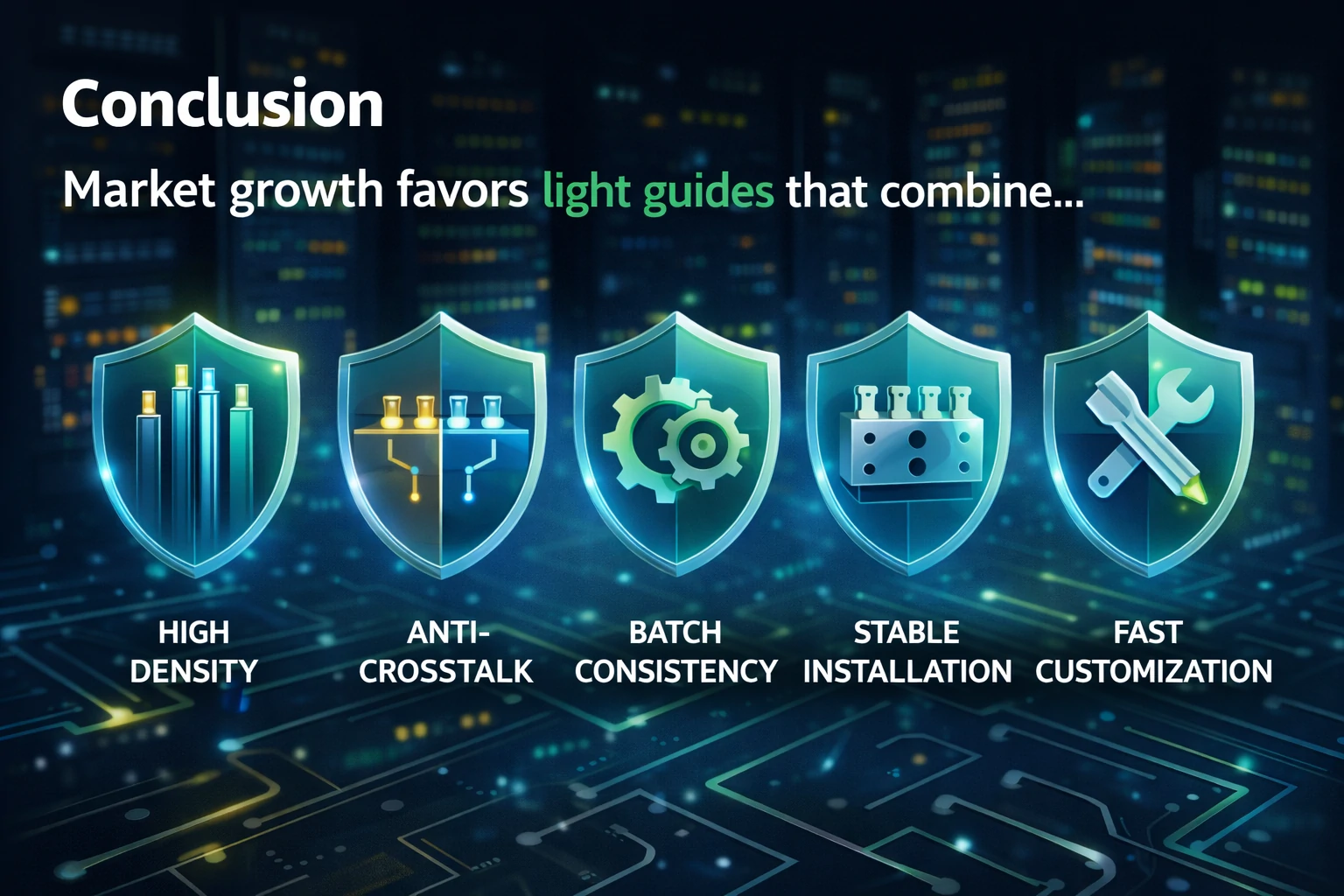
Products with high channel density, anti-crosstalk design, strong batch consistency, and fast customization capability are likely to outperform standard general-purpose products. This is a reasoned inference from public infrastructure data, not a direct light-guide forecast published by a single research house.
The structural opportunity is not in generic light-transmission parts, but in advanced light guide solutions designed for dense, high-reliability status indication systems.
What can advanced light guide products contribute to this market?
High-density multi-channel integration
As panel space becomes more limited in servers, PLCs, I/O modules, and power systems, light guides must support tighter channel layouts and a greater number of status points in the same area.
Anti-crosstalk performance
In multi-channel designs, independent optical paths, shielding structures, and isolation features help reduce interference between adjacent channels and improve indication accuracy. This is especially important for dense industrial indicators and server front panels.
Batch-to-batch consistency
In volume production, consistency in optical output, dimensional precision, surface control, and assembly stability directly affects OEM yield and field maintenance experience.
Tolerance-friendly installation
When light guides are optimized for PCB hole position, hole diameter, tolerance range, and mounting method, assembly becomes more stable and manufacturing becomes more efficient.
Fast customization capability
AI equipment, industrial control systems, data center power units, switch modules, and communications electronics often require different panel structures, optical paths, and installation methods. Customers increasingly value suppliers that can adapt quickly.
Conclusion
Strategic takeaway
The AI era is not only driving growth in compute chips and data center construction. It is also creating a new demand cycle for critical supporting components. For the light guide industry, the greatest opportunity will not come from generic products, but from solutions that can meet the requirements of high density, anti-crosstalk performance, batch consistency, assembly stability, and rapid customization. As AI infrastructure continues to expand, light guides will play an increasingly important role in status visualization across servers, data center equipment, and industrial electronics.