
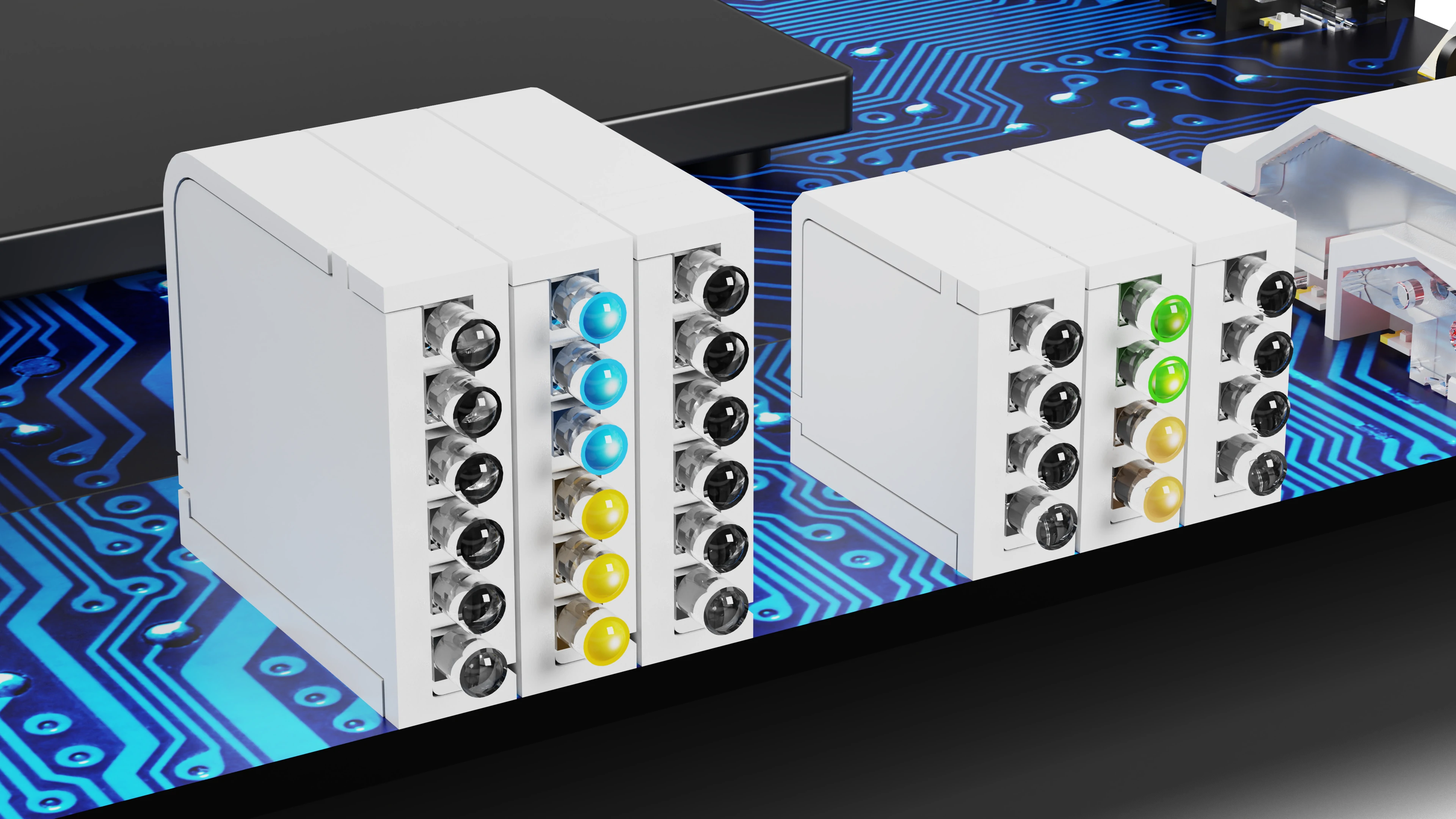
How Anti-Crosstalk Light Guide Design Improves Multi-Channel Industrial Indication
Reducing optical interference in compact industrial indicator layouts.
In industrial electronics, status indication is expected to be clear, stable, and immediately recognizable. This becomes more difficult when multiple indicators are arranged in a compact area. In such layouts, light leakage between adjacent channels can reduce visual separation and create confusion in operation or maintenance. For this reason, anti-crosstalk light guide design has become increasingly important in multi-channel industrial indication systems.
The challenge of compact multi-channel indication
As industrial products continue to become more compact, indicator structures often need to fit more channels into less space. This is common in industrial control modules, automation equipment, communication interfaces, power and energy devices, and front panels with dense status indication.
In these applications, several LEDs may be placed close to one another, sometimes at pitches such as 2.54 mm or similarly tight layouts. When the optical structure is not properly controlled, light from one channel may spread into adjacent paths. The result is crosstalk.
Crosstalk is not only a visual issue. In practical industrial use, it can affect status recognition accuracy, interface clarity, perceived product quality, and operator confidence in signal interpretation.
Typical applications where crosstalk control matters
- Industrial control modules
- Automation equipment
- Communication interfaces
- Power and energy devices
- Front panels with dense status indication
What causes optical crosstalk in light guide structures
Optical crosstalk usually appears when several design conditions come together. One common cause is insufficient isolation between adjacent optical channels. If multiple light paths share a transparent structure without effective shielding or separation, light can spread laterally before reaching the output area.
Another cause is high-density LED layout. When LEDs are placed too close together, diffused light from neighboring sources is more likely to overlap.
Surface control also matters. If the optical structure does not guide light in a controlled way, unwanted divergence can increase side leakage and reduce channel definition. In addition, dimensional variation and installation deviation may worsen the problem if the LED position, PCB alignment, or part geometry shift away from the intended optical path.
Why anti-crosstalk design matters in industrial applications
In consumer products, a small amount of light spill may only be considered a cosmetic issue. In industrial products, expectations are different. Industrial indication often serves practical functions such as operating status display, fault or warning indication, channel-by-channel process monitoring, power or signal confirmation, and equipment interface feedback.
In these scenarios, clear visual separation is directly related to usability. A customer does not only want a light guide that transmits light. They want a structure that delivers the correct light to the correct output position, with minimal ambiguity.
Key design approaches for reducing crosstalk
1. Independent optical paths
When each channel is designed with its own defined optical route, lateral light leakage can be significantly reduced, especially in dense multi-channel arrangements.
2. Shielded or isolated structural design
Shielding elements or isolated structures help reduce interference between adjacent channels and maintain clearer output boundaries.
3. Controlled optical surface design
Mold finishing, polished output surfaces, and controlled optical areas influence how light is transmitted and emitted, helping reduce unwanted scattering.
4. Matching the structure to the LED layout
Better performance usually comes from evaluating LED spacing, PCB-to-panel distance, output position, and installation constraints together rather than designing the light guide in isolation.
5. Dimensional consistency in production
Consistent tooling, molding control, and inspection procedures help maintain intended anti-crosstalk performance in volume production.
Anti-crosstalk design and high-density layouts
High-density multi-channel indication is one of the most demanding scenarios for a light guide system. When several channels are integrated into a narrow structure, the design must balance compact size, visual clarity, structural strength, manufacturability, and installation reliability.
This is where anti-crosstalk design becomes more than an added feature. It becomes part of the core engineering logic of the component. A well-designed multi-channel light guide should not only fit the available space. It should also preserve channel independence, support stable optical output, and remain suitable for mass production.
Practical value for OEM and industrial equipment designers
For OEM engineers and product developers, anti-crosstalk capability can bring several practical benefits. First, it improves interface clarity. A clean and readable indication layout supports better product usability and a more professional appearance.
Second, it reduces the risk of design compromise in compact systems. Instead of enlarging the panel area or increasing spacing, engineers may be able to keep a dense layout while still maintaining readable signals.
Third, it helps align optical performance with industrial expectations. In many industrial markets, product quality is judged not only by function, but also by consistency, clarity, and reliability in use.
TPT perspective on anti-crosstalk light guide development
At TPT, anti-crosstalk design is an important part of how multi-channel light guide structures are developed for industrial applications.
- Optical path separation in dense layouts
- High-density multi-position structures
- Shield-related design approaches where needed
- Structure evaluation based on installation and application requirements
- Production-oriented consistency in tooling and molding
Conclusion
As industrial devices become more compact and multi-channel indication becomes more common, crosstalk control is increasingly important in light guide design. Anti-crosstalk light guide structures help improve channel separation, reduce visual ambiguity, and support clearer status indication in dense industrial layouts. For OEM designers, this means better interface clarity, more efficient use of space, and stronger confidence in the final optical performance of the product.